Showing posts with label National Theatre. Show all posts

Wednesday, 28 November 2012

This House by James Graham, National Theatre

17th November 2012

I am devoting more attention to Front of House details and for visually impaired people.  This includes the box office on the phone, in person, an audio CD and a greeting at the event itself.  The National Theatre ticks all these boxes and a performance is stress free. 

On a cold November lunchtime, some early arrivals were let into the box office area as the NT staff were going through the details of the performance back up for visually impaired visitors.  My companion counted 2 dogs and about 6 canes in the audience and I had a chance to speak to a few visitors who are regular theatregoers with and without audio description.  In any live performance for visually impaired audiences there are really 2 live performances and the research by Tony and Bridget with the NT staff in putting the whole show together is commendable.  That said the play is the thing.

This House is a play by James Graham and has started in the studio space of the National Theatre known as The Cottesloe.  The play is sold out for the run though will be transferred to the Olivier Theatre in 2013.  The play recalls the events in the House of Commons between 1974 and 1979.  This is shown as the fall of the Heath government, the arrival of the Labour government under the leadership of Wilson then Callaghan then the victory of the Conservatives in 1979 under Thatcher. 

The National Theatre CD had been sent to me a few weeks ago and it contained much information.  This includes information on the set, characters and descriptions with a useful glossary of parliamentary procedure pre-television broadcasting.  At the time only major broadcasts on radio were live and one had to listen to transcripts of events in a programme which still goes out on the BBC- Today in Parliament. 

The play is really interesting as it deals with the relationships of the opposing team of “whips”.  By tradition the whips do not speak to the public and the Whips Office is usually an important part of the “greasy pole” of many political leaders.  They are supposed to know all the secrets.  I remember many of the events referred to in the background. Each year has an echo such as the Silver Jubilee in 1977 and the surprise resignation of Wilson in 1976.

The set is laid out to resemble the green benches of the House of Commons.  The dialogue is very quickfire with typical adversarial snippets when scene shifts occur from office to chamber. 

Many of the characters have multiple roles and appearances.  In order to keep things simple all the Conservatives (Tories) have “Posh” accents and are often described as Tory Twats.  The Labour characters are usually given Northern English accents.  There are non English roles such as MPs from Northern Ireland, Scotland and Wales.   Most of the MPs are referred to with the name of their parliamentary constituency and the Speaker refers to them in this way.  Among themselves, the MPs use other terms of endearment including first names.  We have, for example, a reference to Plymouth – Alan Clark (famous for sex and diaries) and Chelmsford – Norman St John Stevas (pompous constitutional expert and deceased).

The dialogue is filled with snippets of details which kept the Labour Government on a knife edge.  The Labour government managed to survive for most of a 5 year term. The whips office has a blackboard on which the razor thin majority is gradually stripped away.  At the time calculators and computers would have been available but a blackboard is a useful prop. 

In hearing about the set, Tony McBride had walked the length of it and had stopped where important parts of debating procedure are embedded in the chamber.  There are 2 redlines which represent 2 sword lengths apart when in debate.  The Serjeant at Arms still has a sword in the chamber and the Speaker still wore a full bottomed wig and gown.  One of the new Labour Whips plays with his stick of office (not unlike my Whitestick). 

We were introduced to the cast and were taken round the props.  The audience is seated on the benches and there is a working bar on the set with Irish Whiskey (surely shome mishtake).  Chris Godwin took me round the set and as he plays the member for the Western Isles, I asked him how his Gaelic was.  To my surprise he answered in Irish.  I was able to sit in the Speaker’s Chair and it can revolve revealing a cleaner’s cupboard complete with Izal loo paper, not Bronco.  We were also able to handle some of the costumes including a very expensive Savile Row suit said to be worth £10,000 in today’s money.  The suit has apparently made several performances on TV, film and theatre, and is worn by Julian Wadham who plays the role of Humphrey Atkins.

The play itself unrolls as a timeline with much of the drama being between the two deputy whips.  In real life, this was Jack Weatherill played by Charles Edwards and Walter Harrison played by Philip Glenister. (Obituary on BBC website: http://www.bbc.co.uk/news/uk-politics-20080858 )  For political junkies, broadcasts of the real events and dramas in the House of Commons can be found on the BBC and other channels as well as on radio.  At the time transcripts of debates in the house were taken by Hansard and with some redaction, appeared in the Parliamentary Report.  This continues to this day and is available on line at http://www.theyworkforyou.com/search-hansard/?gclid=CMCkyJXh77MCFSTLtAodbQ8Abw

Members of the cast who were present during the Touch Tour included:

Christopher Godwin  - (Walsall N/Speaker in Act II/Plymouth Sutton/Ensemble)
Giles Taylor - (Speaker in Act I/Mansfield/Serjeant at Arms in Act II/West Lothian/Ensemble)
Tony Turner – (Bromsgrove/Abingdon/Liverpool Edgehill / Paisley / Fermanagh /Ensemble)
Rupert Vansittart - (Esher/Belfast W/ Ensemble)
Julian Wadham - (Humphrey Atkins, Tory Whip)
Gunnar Cauthery - (Clockmaker/Peebles/Redditch/Nuneaton/Ensemble)

Jane Suffling, the Stage Manger, was also present.

This play will transfer to the Olivier Theatre in February 2013.
http://www.nationaltheatre.org.uk/shows/this-house

Conclusion: The seating in this show added to the drama and if this can be replicated in a larger theatre it should transfer well.  Much of the detail will go over the heads of those who have forgotten the late 1970s but the detail does not detract from the drama of the apparently wasted effort in politics at the time, though having listened to several political books recently (Andrew Rawnsley on the End of the Party (Labour)) it appears that little has changed.  For the sake of balance the term Omnishambles comes to mind. 

By the way the part of the Member for Roxburgh, Selkirk and Peebles was not creepy enough! I ran across him when he was canvassing to be Rector of Edinburgh University in the 1970s. (Gordon Brown had at least been successful in getting that post.)

Thursday, 18 October 2012

One Man, Two Guvnors: Theatre Royal Haymarket- London

13th October 2012

With the audio CD from the National Theatre fresh in my mind, I attended a touch tour and performance of One Man, Two Guvnors (http://www.onemantwoguvnors.com/) at the Theatre Royal Haymarket in London.  This was a transfer to London’s West End and is a popular show.  My cousins from Australia and London had gone and encouraged me to attend an audio described version.  The show is written by Richard Bean and is loosely based on Carlo Goldoni’s play One Servant, Two Masters. 

The Haymarket is one of London’s oldest theatres and has many interesting features.  The only play I can remember seeing there years ago was George Bernard Shaw’s The Millionairess starring Penelope Keith.  I had treated my parents to circle seats and we were surprised to hear the National Anthem being played.  In those days it was unusual and it turned out that a junior member of the Firm (British Royal Family), Princess Alexandra, was attending.

On this occasion we were treated to the National Theatre’s Reuben Lane greeting us in front of the theatre, taking “Front of House” extremely seriously.  Once the group had gathered, we entered the auditorium and waited for access to the stage and set.  Roz Chalmers, who had recorded the audio CD guide, and Bridget Crowley were doing the description. 

We were introduced to Chris the company manager and Owain Arthur who plays the central character Frances. Owain is the only obvious Welsh voice on the set and his character was carefully explained with the aid of a spare suit.  This checked suit is important as the production has two suits each for the character and his understudy.  In fact Owain had been the understudy and had taken over the role in his own right for the London run. 

Owain “sweats buckets” with a lot of acrobatic moves and dashing about, so fixing his voice and shape is helpful in following the dialogue.  His jacket (coat) is quite heavy though the trousers (pants) seemed lighter.  Other costumes were brought on and we passed around a policeman’s tunic and helmet as well as a dress worn by the character Pauline in the Beverley Sisters routine.

I explored the set which gave a perspective of a terrace stretching down to the promenade in Brighton, 1963.  This is a trick of the set wings and panels.  The stage is quite steep and an idea of the rake can be gained from backstage gazing out to the auditorium, circle and gallery. 

I was joined by Chris who discussed lighting and I asked how much an actor saw of the audience when playing.  Chris said that on making an entrance there is limited visibility beyond the floodlighting.  The theatre has to apply non slip paint to the stage as the gradient is so steep.  Many theatres have gradually been refitted to a flat surface which can be more multi purpose friendly.  This means that dancers have fewer problems and of course allows ice skaters and roller skaters to move about predictably. The Theatre Royal is, however, ideal for presenting a play like Goldoni’s, which is in the commedia dell’arte tradition. 

The panels were hand painted and I could detect stashes of props.  There is a seaside cut out of WG Grace (cricketer) with a hole for the face of someone to have a picture taken.  WG Grace must have been quite tall and while I am 5 feet 11 and Chris is 6 feet 1, WG Grace was that bit taller (hint).  The bleached blonde wig in a beehive with other wigs was on show.  The hair is human and these cost about £450 each with each actor having a personal wig.  Music features in the show and a steel drum and set of car horns was tried out. 

Owain talked more about his part and explained the nature of the play hinting at some audience participation and some element of improvisation, pantomime, vaudeville and music hall. Somehow we got talking about pyrotechnics.  I had spoken about following Hedda Gabler at the Old Vic when she burns a manuscript in a stove on stage.  With an assumed wink, Owain said that we may get a bit of that when he cooked.  However, it was time to make our own stage exits, collect our headsets from Susan and have a coffee and sandwich in a nearby cafĂ©. 

Later, and back at the theatre, we were taken to our seats and Susan came round to check the headsets for live notes and the band The Craze - not Krays, something that my screenreader would not have picked up but which was “pointed out” in audio cd sent beforehand.  The Craze play in interludes and provide music cues for scene changes.  I kept the headsets on for most of the show.  I would have missed a lot of the acrobats and tricks such as the antics of the elderly waiter played by Martin Barrass.  The descriptions were played as live and though the show runs to some script a lot of judgement is necessary for the describers in when to interject and when to stay silent. 

In the show itself there are few puns or even innuendo.  Times have changed from the 1960s double meaning, smuggled lines (Round the Horne, Benny Hill  and Carry On) and though political correctness is still part of our self censorship culture, there are some interesting references.  Look out for references to Parkhurst or even Woolworths .  This genre relies on the comedian’s art of going off script in a controlled way and is a common feature of an oral tradition from Homer (Greek poet not Simpson) to the late Max (I wanna tell you a story) Bygraves.   

The programme notes comment on Venetian commedia dell’arte and its decline. It certainly had an influence in both opera seria and opera buffa.  One only has to consider the Richard Strauss opera Ariadne auf Naxos and imagine some scheduler combining the One Man Two Governors with Verdi’s Requiem.  I am sure Owain Arthur could fit the bill as Zerbinetta in the Richard Strauss canon- the other Strauss and his Fledermaus with Arthur in the role of Orlovsky would be so passĂ©. 

The extent of audience participation is a mystery.  I was sitting next to a member of the audience who offered a tsatziki sandwich to Owain.  There was some banter but the man did not return after the interval.  (Was he given the concrete overcoat during the break?) Some of my fellow audience were amazed at the scene where a member of the audience was handled on stage. (She was hidden behind the cut out of WG Grace.)

This was a very funny and entertaining show.  The music was of its time and on hearing someone behind me mention Hank Marvin, I thought of the Shadows and asked if one of the guitarists was wearing glasses.  He was. 

Covent Garden is currently “doing” Wagner’s Ring Cycle …

Tuesday, 9 October 2012

Last of the Haussmans by Stephen Beresford

6 October 2012 Lyttelton Theatre, London

This was a matinee performance with a touch tour beforehand.  The National Theatre sends an audio CD with notes on the play with descriptions of the set, the characters and their clothing. 

At around 12.45, we gathered in the foyer and were taken back stage in the Lyttelton Theatre.  Andrew Holland, one of the describers, with Tony McBride was there to explain the complex set which is a house on a revolving stage.  The revolve mechanism is sparingly used in this proscenium theatre though the set was open to view at all times. 

The house is in a state of dereliction with clutter gathered from the originally inherited property, along with trinkets, ephemera and junk associated with the 1960s.  We were invited to explore the set.  Two weeks ago, we had the thrill of being revolved on the Olivier set.  However, the set for the Last of the Haussmans has much tighter clearances and requires some nifty footwork on the part of the actors. 

I wandered around the stage and my cane picked up the cobbled terrace surface with moss, reminding me of monoblock driveways which are magnets for jet clean cowboy merchants.  Inside the house itself, I was in a dining area, then the sofa and coffee table room when I noticed an ashtray and dipped my finger in it.  Expecting some authentic National Theatre cigarette ash and a few stubs, I was surprised to feel a cool wet liquid.  Later on in the kitchen I was joined by David Milling, the stage manager, and we discussed props in the kitchen and I asked about the ashtray.  Back came the answer that it was KY Gel. 

David explained the significance of some of the props including the use of the loud hailer or megaphone to be used by Judy (Julie Walters).  Stephen Beresford had recalled an incident when boat trips approaching a relative’s would announce the appearance of some of the properties in view and the relative would pick up the megaphone and shout back.  I understand the feeling, having shouted back to the radio.   We continued to discuss theatre, audio description and how helpful these touch tours are to visually impaired people who can’t observe some actions on stage or indeed identify some characters. 

At this point we were joined by someone who introduced himself to me as Rory and I asked if he was Rory Kinnear, who plays Nick.  It was indeed Rory Kinnear and as the Haussmans is very much a product of the 1960s, I mentioned that his father, Roy Kinnear, had spoken at my school in Edinburgh around 1967.  Rory discussed his part in the play and some questions were asked about his costumes and how “filthy” they were in reality.   

Soon it was time to get our headsets from Reuben Lane who gave us directions in finding the correct door to get to our seats.  Large print copies of the cast list were also available.  The performance started at 14.15 and the audio description started about 20 minutes before with Reuben making a sound check. 

Characters in order of speaking

Libby – Helen McCrory
Nick – Rory Kinnear
Summer – Isabella Laughland
Judy – Julie Walters
Peter – Matthew Marsh
Daniel – Taron Egerton

Stage Manager – David Milling

The play follows in chronological stages, cued by lighting and revolutions of the set.  Themes of sibling rivalry are introduced by Libby and Nick and then the stroppy teenager enters.  The dialogue is current, though there are some references to certain British institutions such as the broadcasting Dimbleby.  Some knowledge of the geography of Plymouth and South Devon is useful as is the predilection of the British for the Donkey Sanctuary. 

This play could certainly transfer to The Hamptons, Hilton Head Island, Starnberger See or Lake Geneva.  The dialogue is slick and timing excellent.  The audio description is useful in getting some of the cues such as the lighting of a cigarette and the opening of an over shaken drinks can.

The programme notes are sparse apart from a timeline through the period from 1960 to 1978 and extracts from speeches or articles by characters then and later on such as Dominic Sandbrook, Arthur Marwick, Jenny Diski, Mrs Thatcher and Tony Blair.  The play evokes memories for those of a certain age now that the 1960s are being contextually analysed by talking heads.  Much of the experience of the 1960s has always been parodied by those who say that if you could remember the period then you did not live it.   I overheard some people behind me commenting on the aged hippy syndrome. 


National Theatre webpage for The Last of the Haussmans: http://www.nationaltheatre.org.uk/shows/the-last-of-the-haussmans

There is an interesting video on YouTube of cast interviews as well as comments by the playwright Stephen Beresford.
http://www.youtube.com/watch?NR=1&v=TdFcnQgYF3k&feature=endscreen

The play will be broadcast live to cinemas across the UK and internationally.  More information on dates and venues is available on:
http://microsites.nationaltheatre.org.uk/70220/productions/the-last-of-the-haussmans.html

Information on other NT productions to be broadcast can be found on:
http://microsites.nationaltheatre.org.uk/ntlive

There is also an interesting video on the NT website with Tony McBride talking about the process of audio describing a play:
http://www.nationaltheatre.org.uk/video/audio-description

More information on facilities at the NT for the visually impaired can be found on:
http://www.nationaltheatre.org.uk/access/facilities-for-visually-impaired-people

Friday, 28 September 2012

Timon of Athens: National Theatre London

22nd September 2012

This was an audio described (AD) performance of Shakespeare’s Timon of Athens.  This play is a bit of a rarity and some estimates have been made that the input of Thomas Middleton accounts for as much as 30% of the play. 

Having joined an access list at the National Theatre, I received an audio CD in the post with an introduction to the performance, play, set and cast lists.  Production notes are also made and on this occasion there was a specific remark by Karl Marx which fits in well in relation to this production. 


On the day of the performance I went to the touch tour of the set with an informal walk around the set as well and a chance to discuss the production with the stage management and some of the cast.  There is also a very attractive exhibition of Timon of Athens in the foyer and I listened to one of the videos which discussed Jacobean plays, tragedy, city comedies and the politics of King James I/VI.  King James was known as the “Wisest Fool in Christendom” and with the saying “A Fool and his Money are easily parted” the background to the play can be set.  While the programme quotes from Marx there is an additional Marxism – Gold sein oder Gold Schein?

We gathered at the Olivier Box Office which has a backdrop of the Milennium Wheel and the Thames.  Nick welcomed us with a team of staff.  Reuben remembered me from Detroit and I was introduced to Rosalyn. The staff see the run of a play develop and can often give useful tips on other productions at the National Theatre. 
 
On the set itself we were introduced to the company by Andrew Holland one of the describers with Bridget Crowley.  When the actors are introduced to us they are invited to use both their normal voice and the role voice.    We then enjoyed an additional treat; the stage revolved with us on it.  I have walked the set before on the Olivier and my cane has run along the circular track of the movement mechanism. I questioned how fast it went in rpm (betraying my vinyl records days) and after our revolution I was told by Kerry McDevitt, the stage manager, that it took about 30 seconds from a standing start to do half a revolution. 

On the set there is a descending wall with 2 doors and a centre piece which was  used as a mini stage for a ballet piece, a projection of a painting in the Timon Room of the National Gallery and a view of the City of London from an investment bank- it happened to be a shot of HSBC according to my companion.      Knowing how the theatre and set worked it was time to view the set props and I was taken round by Ciaran McMenamin, who has the part of Alcibiades, a notorius troublemaker and rabble rouser from 5th Century Athens. 

Ciaran took me round the banqueting table and settings, some luxurious sofas and the trolley and trash piles with the occupy tents.  Ciaran had studied at the Royal Scottish Academy of Music and Drama in Glasgow so we discussed Glasgow and Edinburgh; as well as the role of Alcibiades, as he appears in Plato’s Symposium and in Thucydides’ Histories: a rabble rouser and turncoat from history, used by Shakespeare and then translated to the modern financial crisis in the banking and financial markets. 

At this stage we were joined by Bridget Crowley carrying a pair of ballet shoes.  As the dancers were going to be dancing on point, the wooden blocks could be felt.  I asked if the shoes had been made by Freed, as the Royal Ballet gets their shoes hand made.  We discussed audio description in ballet- a deep philosophical debate which will be continued. 

We were now ready to enjoy the performance of Timon of Athens.  The action could be followed, with some of the actors being recognised from the context, some from the script dialogue and others on the AD cue.

The play really gets interesting with the soliloquys of Timon, played by Simon Russell Beale.  The city comedy back chat was as topical as ever with returns on capital, usury, bonds and bankruptcy themes.  Outrageous consumption is familiar enough, though Timon does star when his anger shows and the banquet before the interval is a real shocker.  Having studied Trimalchio’s Dinner (Satyricon) by Petronius and recently read Mrs Mackenzie’s Dinner (Miss Mackenzie by Anthony Trollope – Talking Book number 017243) I was quite unprepared for the shocker of Timon’s final banquet, where the solids do hit the air conditioning. 

The second half is where gold, greed and duplicity get a thorough going over.  The ending of the play is a weak point.  We know nothing about Timon apart from his “friends” and there is no family to frame him.  Timon writes his own epitaph (over the grave) and presumably dies offstage.  “Obscene” Alcibiades now joins the suits and the oligarchy continues.  Nothing changes. 

Conclusion

With audio description and a live performance there are really 2 live performances.  The describer has to anticipate what an actor will do while the actor both acts and reacts to an audience.  Warnings are made on the headset in advance of noisy passages on stage and I could not hear the AD as I was very close to a crowd scene.  The AD in the ballet scene was difficult for me to unravel.  I have difficulty in listening to the music, working out what is going on with the dance and then interpreting the description of the dance.   The touch tours greatly add to the enjoyment of the performance and I also found the Timon of Athens exhibition at the Olivier to be very informative.

The National Theatre will be broadcasting a performance of Timon of Athens live on 1st November to selected cinemas in the UK and abroad.  For more information go to: http://www.nationaltheatre.org.uk/shows/timon-of-athens

Note: When at school, we studied Shakespeare using the Signet Classics paperbacks.  There is a 1965 edition of Timon of Athens which cost 3s 6d (three shillings and six pence or 3/6 for those who can remember!).

Thursday, 26 July 2012

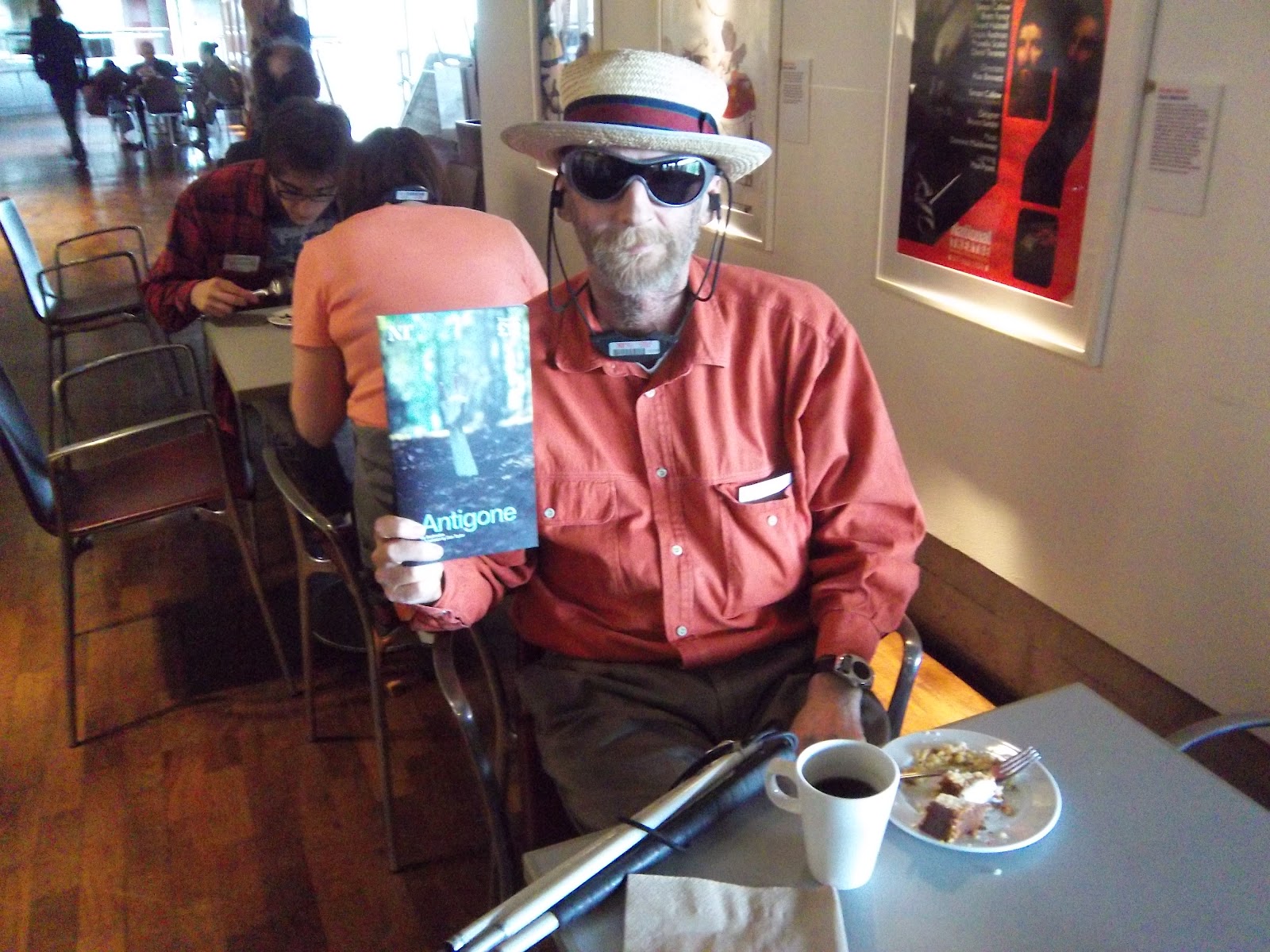
Antigone - National Theatre, London

21st July 2012

I had studied Antigone by Sophocles during a course at the Open University (I covered the OU in my beginner’s blindness series.). Sophocles is one of three tragedians from 5th Century Athens, the others being Aeschylus and Euripedes.  At this point screenreaders will have noticed the mess JAWS makes of some Greek names.  Spelling variations make searches for Greek dramatists or poets as difficult as Dutch or Flemish artists. 

Antigone is reckoned to be the 2nd play of Sophocles after Ajax, but is NOT part of a trilogy with other Oedipus stories.  Sophocles invented the 3rd character speaking on stage at the same time.  His early work is a mix of speeches, dialogue and back story filling.  Greek drama regarded violence and killing as “obscene”, meaning it had to be done offstage.  At the end of a play there is a body count and Antigone is no different. 

My joining the National Theatre’s access programme allows me to have a CD sent to me with all details of performance, set, actors and descriptions.  Helpful hints on making the best of the trip are also provided. 

First stage: CD arrives

Chorus split into many voices.
I wondered how complicated this would make the play and how on earth was the describer (Bridget Crowley) to keep up with so many more speaking roles.  

Set 40 years ago. 
This could refer to many authoritarian regimes and hints are given to a possible country with no political democracy. 

Cast list and detailed set and props. 
This enables one to recognise an actor who may be well known from other work in theatre, radio and TV from the voice.   After 2 listens to the CD I had an idea of the set and props in my mind. 

Second stage: Touch Tour of set and meeting the cast

Introduced to company and cast: Creon (Christopher Eccleston), Haemon (Luke Newberry), Teiresias (Jamie Ballard) and one of the chorus (Craige Els). 

Craige’s role in the production involved acting as henchman in chief of Creon.  I was shown desks, rooms with glass walls and bunker concrete walls which had been broken.  Craige explained the use of the revolving stage and my cane managed to do a full circuit of the groove track on the Olivier stage.  Craige took me round the set while we discussed likely authoritarian regimes.  I have known a few from the 1970s onwards.  The bunker mentality did not stop with 1945.  We discussed the translation and how true the performance of Antigone really was. 

At this point it is worth noting that the Ancient Greeks thought nothing of fitting legend into modern Athenian politics.  A major unresolved issue was usually set in Thebes which can be described as an anti-Athens.  Other writers used themes from the Trojan War or Greek Theology as metaphors for some political dissent.  All the writers including the comedy writer Aristophanes served in the army.  At the time of Antigone, the Athenians were yet to set out on a prolonged war with Sparta though they had enjoyed a period of stability with Pericles.

The main characters are:

Antigone played by Jodie Whittaker
Ismene played by Annabel Scholey
Creon played by Christopher Eccleston
Haemon played by Luke Newberry
Teiresias played by Jamie Ballard
Eurydice played by Zoe Aldrich
Messenger played by Kobna Holdbrook-Smith

Third stage: the performance


Prof Whitestick fortifying himself before the performance
Antigone, National Theatre, London
21 July 2012

About 15 minutes before the performance a live description can be heard on the infra red headsets provided and checked at your seat.  This enables the set we have visited to be placed in context.  There is some action from the chorus and one can adjust to movement.  This is virtually a Parados. 

The play starts dramatically in the end of a bloody battle in which Antigone’s brothers Eteocles and Polynices have killed each other. Creon has decreed that the latter must not be buried.  At this point the ancient Greek battle of civil law and moral code breaks out.  Antigone stubbornly sticks to the rules of the gods/nature (physis) while Creon, newly crowned, rules by decree (nomos meaning man-made).  The problem cannot be resolved and leads to dramatic entries, messages and the fore-telling of the last moments of some of the characters.

Greek plays are suitable for visually impaired people as the dialogues and speeches are fairly easy to follow.  In keeping true to the text but complicating the chorus role, the NT handed Bridget a tough job in keeping up with the entries and stage movements.  Bridget had warned in the CD that shorthand names would be used for the characters in the production formed as a chorus.  

The play has some in-built tension at the beginning with some of the music beating out dactyl (dah diddy) rhythms.  Most of English prose and poetry is based on iambic pentameter whereas much classical Greek poetry and Latin uses dactylic hexameter.  Stage English sounds uncomfortable in this meter and this added in my mind to the tension about to explode in scenes with Antigone and her sister and later with Creon. 

The music and sound effects were overwhelming at points and having been told at Detroit that my headset was a bit loud (by a friend) I was careful to turn down the description when I felt I did not need it.  In this production the audio description is important in understanding how Polly Findlay (the director) brought Sophocles’ version of Antigone up to date.  Not long after I lost my sight I went to the National Theatre production of Iphigenia in Aulos.  Knowing the story helps in many of these 5th Century Athenian plays.  In a small studio one can get away without the audio description, but one misses part of the story. 

The unsung heroine of the productions was of course Bridget who gave another live performance.

Finally, if Helen of Troy launched a thousand ships, then Antigone launched millions of 6th form and undergraduate essays, which this post is gradually morphing into …

Monday, 2 July 2012

Detroit by Lisa D’Amour at Cottesloe, National Theatre London

Audio Described and Touch Tour 30th June 2012

Detroit is the 2nd performance I have “seen” at the National Theatre in London with audio description. (http://www.nationaltheatre.org.uk/detroit)  I had been to The Cherry Orchard by Chekhov last year, going on my own and taking in a touch tour beforehand.  I had got out of the habit of booking far ahead on account of my hip problems.  However, a friend nudged me into going again as I had expressed an interest in seeing the National’s current production of Antigone.  I duly called the National’s box office and during my conversation with the helpful staff not only booked to ‘see’ Antigone, but managed to book for Detroit in addition to having my records at the NT updated!  It is worthwhile checking that your access needs are noted.  (http://www.nationaltheatre.org.uk/access)

I thought no more about it until an audio CD arrived in the post - a pleasant surprise, as it contained detailed information about my performance dates, touch tour, programme notes and set details with a cast and credit list.  The CD had other useful information and on playing the Detroit references, I had an idea of the set, costumes and found I could identify two of the actors by name and voice from their radio work.  (This can stop me from whispering ‘I’m sure he/she plays ABC in…’ )   The CD was recorded by one of the describers Tony McBride.   I made a mental note of two particularly striking details mentioned on the CD: one was a reference to a rusting aluminium door and the other to a tortoiseshell clasp in the hair of one of the actors. 

Outside National Theatre
London
30 June 2012
© Prof Whitestick

On arrival at the Cottesloe, we were welcomed by Andrew Holland, who was one of the describers along with Tony, and by Duncan. 

Later, we were assembled and Reuben led us into the theatre and onto the set, where we grouped beside the aluminium framed mesh door. Andrew introduced us to most of the cast.  These were:

Stuart McQuarrie (Ben)
Will Adamsdale (Kenny)
Christian Rodska (Frank)
Justine Mitchell (Mary)

The fifth character was Sharon, played by Clare Dunne.

The cast spoke in character and were in costume but also spoke in their own voices.  I was shown the mesh door and opened it.  Behind was some cheap and old linoleum flooring signifying decay in the house (and the suburbs?).  An artificial flowering plant grew out of a gap and Stuart guided me to it.  I asked Christian if he was wearing clean deck shoes as announced in the audio notes.  He wasn’t, but his part (Frank) does not come on until the end of the play.

I was then taken over to the other half of the yard set and spoke to Will (Kenny) and Stuart (Ben) over the BarBQ.  This had been shipped over from Chicago and is gas fired.  Though it was out of my sight line (I could not have seen it), it is the focus for several key points in the dialogue.  A repeated line from Ben is “Put these puppies (steaks) on the grill”.  A pair of tongs too is used as an important playful prop in the play. 

I chatted with Andrew about audio description and we were joined by Stuart.  I mentioned my blog and the guest post by Neville Watchurst.  Andrew said he had done work on television too.  I asked how strict the direction was as with only two audio descriptions in the run it must be meticulous in the timing.   A describer has to both know the play and the likely outcomes of a move into an improvisation or extemporisation.  As no two performances are alike so no two descriptions in real time are the same. 

Next, I spoke to Justine (Mary) over the deck table with shade and tablecloth.  The colours of the shade and its unreliability open the play as do the sliding doors of the patio (deck). 

I found the access we had to the set, combined with the interaction with the cast and a describer very useful in adding to the audio CD input in my mind. The detail in the design and layout of the Cottesloe Theatre is very useful, as are the seats for visually impaired people.  Some large print and Braille notes were available and these were distributed to those who asked for them.  (Someone I had met at a National Gallery talk had asked for some details too.) 

The tour finished, we had a little over an hour for a coffee and sandwich in a cafĂ© in the NT complex by the river. 

On returning to the Cottesloe Theatre I came across the bust of Cottesloe on the left hand side of the door.  Following my previous experiences with Elgar, Keats, Wellcome and Van Gogh’s doctor, I tried the bust. 

Lord Cottesloe at entrance of Cottesloe Theatre
National Theatre, London
30 June 2012
© Prof Whitestick

For the performance, I was given the Infra Red audio headsets and told how to use them.  Reuben guided me to my seat which was on the apex of an isosceles triangle with about 75 degrees of audio about 3 rows up from the floor.  This is an ideal spot as the headsets give an obvious 180 degree audio signal.  Shortly before the performance was due to start, Reuben came round checking that we could all listen to the audio prologue.  This gives useful information about action, lighting, noises and a tip to turn up the volume and turn the headset volume down again. 

The play opens against a backdrop of aircraft approaching and this reminded me of Detroit’s DTW airport, beloved of those in certain industries.  The play features two couples in a very rundown neighbourhood facing challenges.  The area is described as a first ring suburb with additions, neglect and some properties being “home improved”. 

I remember Derek Jarman’s film Jubilee shown during the Queen’s Silver Jubilee.  This illustrated a dystopic view of London and a somewhat feral nature of the society.  The picture of suburban life in ‘Detroit’ gives an idea of nature taking over developments and a breakdown in some parts of society.  Sharon and Kenny are unashamed “White Trash” though more so than that portrayed by the sitcom Roseanne. 

Having driven through parts of the US Rustbelt in the 1980s and 1990s I was prepared for some of the references and dialogue.  Mary’s pretensions with her Hvarti cheese and caviar are neatly juxtaposed with Sharon’s nibbles such as saltines and delta caviar.  During the play there are also references to Solar Power Drive or Ultra Violet Road (which fitted neatly with my Infra Red headset) in addition to the US Freeway numbering system.  However - and without giving anything away - there is quite a long dance sequence which would have been lost on us without the graphic descriptions of the audio describers.  The play translates very well from its Chicago first showing and  it speaks for itself as a performance with the input from Andrew and Tony.

So, well done National Theatre!  This was a very imaginative way of giving some of us an idea of what is going on.  The combination of audio CD, touch tour and audio description was ideal. 

Production Notes

These notes have been taken from the material made available to us and also from the flyers.  These were read to me by my companion though if on your own questions can be asked.

“The world premiere of Detroit was produced and presented from 9 September to 7 November 2010 by Chicago’s Steppenwolf Theatre Company, Artistic Director Martha Lavey, Executive Director David Hawkanson.”

Other posts to do with description are:


Prof Whitestick has also reviewed the following:


Sunday, 10 July 2011

Review of The Cherry Orchard at The National Theatre

I mentioned before that I had booked a touch tour and audio description for a performance of The Cherry Orchard by Chekhov.  This has been playing at the National Theatre (NT) - www.nationaltheatre.org.uk .  So, with all the booking arrangements made, I went to the NT on my own via Waterloo Station. 

I was pleasantly surprised that all the staff at the NT, including the cafe and Information Desk, were aware that the touch tour for 12:30 on Saturday 9th July assembled at the second floor box office of the Olivier Theatre.  I was escorted to a cafe then the box office and met William who gave me the earphones for the audio description.  The earphones are based on an infra-red system which only works in a specific theatre within the NT complex.  I had visions of being in The Cherry Orchard listening to something else, such as a News of the World hack!  William pre-set the channel and explained that 15 minutes before the performance the audio description would outline the play.

Having been kitted out, the group assembled and we went back stage on to the set of The Cherry Orchard itself.  Ros, who is Head of the Access Department at the NT, gathered us in a semi-circle and then introduced us to Kenneth Cranham.  I recognised the voice instantly -it’s sort of gravelly and you can hear him on the John le Carre Smiley series from the BBC.  He plays Inspector Mendel.  Kenneth talked about the play and was joined by Zoe Wanamaker and other actors.  We discussed aspects of the roles within the play and the construction of the play itself, with comments on the background to Russia in 1904 and the general decline of landed estates, the coming of the railway, communications such as telephone and telegraph and electric light.

We then met the stage management and the wardrobe department and I was shown some of the incredible detail such as wallpaper, photographs, books, and a bookcase which is central to some of the action.  It was interesting to note that the NT makes some of its furniture and this bookcase had been ‘distressed’.  I could feel the candle wax on the surface and go inside some of the bureau compartments.  One of the stage management showed me the 'Russian' newspaper peeling from a rear wall which could only have been noticed by a few in the auditorium!  I was also told that the matchboxes were authentic as was the paper money.  The significance of the telegraph post was useful as a landmark which my peripheral vision could pick up.  Some of the costumes were also available to inspect and we then met the transcribers: Ros, Bridget and Neville (I think).  They explained how they interacted with the action on the play and as they had to do this on a live basis, it couldn’t always be scripted. 

The tour lasts about half an hour and there is about an hour before the performance so it’s possible to get a snack or rejoin your friends, if you’re sitting in the auditorium with others.  There is no need to sit in a designated area as the infrared earphones work in the auditorium.  I was assured that the earphones do not interfere with other peoples’ enjoyment of the play, so I didn’t notice a mass exit of the audience around me.  I was escorted to my seat and got a programme which I will have to ask someone to read, but wanted as souvenir.  The NT has large print cast lists and a version in Braille is available.  Information can of course be found on the NT website. 

I’m not going to go into much detail of the play itself, but only to say this was Chekhov’s last play before he died and it reflects the usual issues of the interaction between family, class, money and developers.  These themes haven’t changed over a hundred years, so the play is still topical.  When chatting with the audience, I was able to remark that the describers indicated the name of every new character and used a variety of names by which each character is known in the play, for example: Mark Bonnar plays a character who is referred to by a first name and a patronym, so this is a possible double confusion which the describers neatly avoid, though Mark’s Scottish accent is genuine (I heard an American remark how wonderfully his Scottish lilt had been rendered in the play ... in much the same way as Scottish accents are used in some of the Aristophanes comedies whenever a Spartan is playing). 

I found I could take the earphones off as you can hear the theatre audio line directly.  As the play begins, I had a 45 degree audio line, which opened up to about 80 degrees when the set on the Olivier was fully opened.  The play starts very much in the form of a Greek tragedy, with a scena and a door and this is transformed into an open stage during the first part of the play.  As we had passed through the backstage area, we had been aware of the props and these were described as they were used in the play itself at key moments when the dialogue would not be so helpful.  Having the headset under my own control meant that I could take it off and on and I usually put it on when there was a music cue or a lighting change, which I can detect. Without giving away the ending of the play, I would say that the final 10 minutes should be used in conjunction with the earphones.  I find I can be a pest when asking ‘What happened?” at the end, but it’s not always obvious and unlike the Seagull, there is no additional sound effect. 

A very big thank you to the NT Access Department for both the touch tour and the audio described performance.  This certainly makes going to the theatre on one's own viable, but also socially enjoyable.  You don't have to ask friends to read the programme notes and can concentrate on the bar instead!

Friday, 10 June 2011

South of the River

To many people living in London, the River Thames is a frontier between north London and south London.  Paris might have ‘rive gauche’ (left bank and right bank); in London, however, the River is treated as a straight east-west axis, though of course it meanders through the city with some parts of south London being further north than parts of north London.  Many people who live in London describe crossing the river as a visit to another world and it’s almost like crossing the River Styx.  Luckily the modern day Charons offer return trips, so it’s not all a case of Orpheus and Eurydice.

I referred in a previous post to a trip on the River on Thames Clippers.  If you have a Freedom Pass, check for discounts.  Crossing the river by bridge is also interesting as there are several road and rail bridges across it and you can get a good idea of the Thames as an artery when the tide is in and a bit of a mess when the tide is out.  If you have a hat, hold on to it as the bridges can be very windy and Waterloo Bridge in particular can make you feel very cold and exposed – and it is a lot longer than it might appear.  Hungerford Bridge used to be an assault course, but in its modern state, together with the South Bank developments, means it is much more accessible.

I made my first solo trip on Tuesday across the bridge from Charing Cross underground station.  You can get off at the Embankment, but I know my way out of Charing Cross on my own though always ask for help in getting back into the underground system.  The bridge is a pleasant walk and will lead you over to the South Bank, which is celebrating 60 years since the Festival of Britain in 1951. 

I wanted to find my way into the Royal Festival Hall (RFH) and had completely forgotten how to get in.  In these circumstances you can usually find a restaurant or a shop and if you hear the sound of money, you can be sure that someone will be able to direct you.  In my case it was the bookshop and through a few questions of the ‘where is the box office’ variety, I found myself at the said box office, where on a whim I got a ticket for Tuesday night’s performance by the Royal Philharmonic with Charles Dutoit conducting and Nikolai Lugansky (piano) with a programme of:  Berlioz/Weber’s Invitation to the Dance, Beethoven’s Piano Concerto No 4 and Stravinsky’s Rite of Spring. 

The box office staff were extremely helpful and checked my requirements including that of the dog with their accessibility database.  The concession is a half price ticket and one for a guest at the same price.  So, two of us went to a programme which ought to have included Martha Argerich, but she had cancelled.  Incidentally, the concert was broadcast on Radio 3.  There is only one box office on level 2 of the RFH, and the staff generally are very helpful and will guide you to your seat.  If you’re meeting someone, there are tables and chairs and comfortable sofas near the box office and it is good as a rendezvous point (if you haven’t got a Smartphone).

After having booked a ticket, I decided to explore the South Bank and was attracted by a lot of bright yellow, which is one of the few colours I can make out reliably.  There is a lot going on here and the site is currently laid out resembling a beach or lido with deck chairs, beach huts and boating exhibitions. 

I managed to find the National Theatre, entered it and gravitated towards the box office.  Again, they were very helpful, put me on their accessibility list and, once again, inquired about the dog.  I was also told about the current programme and told them that with the help of a friend I had booked into a touch tour and performance of The Cherry Orchard by Chekov. 

This news was of interest to someone else, who told me that Chekov had written precise instructions regarding stage direction and props, and that most productions of Chekov, wherever performed, tended to adhere to the playwright’s directions.  This was news to me, though I can remember seeing The Cherry Orchard at Edinburgh many years ago.  

A couple of transport comments: 

Accessibility for wheelchairs is not something I have commented on and is beyond my competence.  Obviously, access at some stations is restricted, though ramps and lifts have been installed at many stations.  I’ve recently been changing trains in East Croydon, Watford Junction, Bletchley and have been to Bedford, Tonbridge and St Albans Abbey on research.  There are no staff at St Albans Abbey station, but it does provide easier access to the Verulamium.  Unfortunately, it was a rainy day when I went and though I did find the Verulamium, I should have taken a waterproof reel of cotton with me.  It was Theseus without Ariadne, though I think I could just about manage to retrace my way on a good day. 

Some of the junctions I’ve mentioned can be useful as interchange rather than using the London termini, though a word of warning on some First Capital Connect services – there are often no announcements on the train so you may have to ask ‘where are we’.  I would advise that you check in with the station staff if using this line as the timetable is also more complex than it would appear.  Service on Southern Southeastern and London Midland, on the other hand, have regular announcements if not automatic ones, and the railway staff are obvious.  

As mentioned before, there is a lot of construction work on Thameslink services.

London Overground : services are frequent, there are announcements and the station staff have always been a useful source of information on tickets beyond the London zonal system, as well as arranging for onward help at Watford Junction (staff there also extremely helpful).  Remember, your Freedom Pass will take you to Watford Junction so you can buy a ticket for beyond, if you feel adventurous!