Showing posts with label Renaissance rapiers. Show all posts

Tuesday, 26 June 2012

Noble Art of the Sword - Study Day, Wallace Collection

On the 16th of June I attended a study day at the Wallace Collection. (http://www.wallacecollection.org/collections/event/4311 )  I arrived in good time to have my 3rd “view” of The Noble Art of the Sword exhibition.  ( http://www.wallacecollection.org/collections/exhibition/93 ) (Notes on my previous two visits can be found on: http://profwhitestick.blogspot.co.uk/2012/05/noble-art-of-sword-exhibition-at.html )


Prof Whitestick at the entrance to
The Noble Art of the Sword exhibition
Wallace Collection
28 June 2012
© Prof Whitestick

One of the staff read out details of a Saxon silver sword with fine silversmith workings and I re-familiarised myself with a few more of the exhibits.  Sarah from the Wallace had sent me the information in text format used for the large print information booklet.  This was ideal and neatly complemented my first tour when my friend Jackie read out the captions on what I could make out or “see”.

There are a few specialist terms and foreign words and authors of fencing manuals which the exhibition explains.  Some of the terms can be checked for the correct spelling which makes further research easier.  I was able to work through items in advance of the study day so that I could follow the speakers.

Through my screenreader I had a virtual audio guide which provided a lot of information on the items in the exhibition.  My screenreader is set to American male voice (Jaws and you do get used to it) and when the cursor came across items in Italian, German and French the screenreader switched to the appropriate language though rather than revert back to my usual American chum it went to a rather plummy and sinister British English!

The programme was as follows and was linked in with the themes explored in the exhibition itself.  There were about 60 people in attendance.

“In the 16th-century it [the sword] became an essential part of civilian dress as well. This study day will examine the complex story of the sword in everyday life during the Renaissance, their role as weapons but also as status symbols, jewellery objects, and works of art. Topics will include the evolution of the rapier, its development, construction and decoration, and its use, which was illustrated in lavish fencing books published throughout the sixteenth and seventeenth centuries.”


1.  Exhibition themes of The Noble Art of the Sword by Tobias Capwell


One of the most interesting aspects about coming to a subject about which one has had little knowledge is the enthusiasm and experience of listening to a curator of an exhibition or organiser of a conference.  Toby had been involved with the concept and preparation for this exhibition for several years (from 2006) so the insight into the subject and the fluency in the talk was stimulating.

The illustrations of the development of the rapier were suitable for my peripheral vision and the outline of a sword’s hilt and blade in a series of 8 was clear in my mind especially when combined with the descriptions and having just refreshed my memory of some of the swords.  Anecdotes are always worth hearing and I liked the story of when Toby was in Dresden and having picked his swords (he could pick 2), the Dresden authorities asked him if he would like the costume of Christian II, Elector of Saxony. It had been put away in 1942 and had rarely been uncovered since. This is one of the show stoppers for me.

Toby went through the design manuals by Orsoni (borrowed from V&A) which were followed by craftsmen.  The fencing manuals arose when an architect Camillo Agrippa wrote down some geometry with fencing.  Fight and Fencing Masters wrote, developed and rewrote manuals from mid 16th Century and characters such as Achille Marozzo, Camillo Palladini and Girard Thibault emerge.


Fencing according to Thibault
Wallace Collection
28 June 2012
© Prof Whitestick

 
The wider access of books on sword fighting allowed some type of Renaissance crowd sourcing to suggest that many masters were influenced by other fencing schools. Toby suggested some work on Camillo Palladini could be done.  For the exhibition the Wallace had gone through Milan archives tracking down the craftsmen involved in all aspects of swordsmithing, jewellery and trade.  Outside of the exhibition is a real-sized fight diagram from Girard Thibault and I positioned my cane on it during a break.

The issue of civilian sword and fashion accessory was raised.  Toby disliked the term accessory, as the rapier was an integral part of a gentleman or nobleman’s dress - as essential as underpants and shoes.  The hilt, dagger, belt, scabbard, doublet buttons and even shoe buckles were made to match.  Being fashionable items they had to match.  With unlimited budgets, the rapier set with costume said a lot.  The rapier then became a ceremonial or non fighting sword though there is much to be debated here.

The fencing manuals in the exhibition were difficult for me to discern and the large enlargements on the screen made the positions and the history of the collections of fencing manuals come alive.


2.  The De Walden Collection of Fight Manuals by Joshua Pendragon, Guest Assistant Curator, The Noble Art of the Sword


Toby and Joshua mentioned the difficulty in showing books in an exhibition as only 2 pages can be shown at once.

Joshua had old black and white film clips of fencing bouts and though far removed from Hollywood, there is still a mystique of the rituals employed.  Descriptions of the fight sketches can make these appear much as in a sketch by Picasso, a set with actors by Zoffany or the Furusiyya horse manuals as shown and described in the current British Museum exhibition.

Serendipity plays an important part in collections and the uncovering of the Howard de Walden Library was explained by Joshua.  George Silver was a writer in England in the 16th Century and had been critical of the craze for Italian fencing masters and some of their habits.  Joshua and Toby had worked on a collection of fencing manuals held in Glasgow forming part of a collection of the RL Scott Bequest.  Tracking down books and documents is part of an historian’s stock in trade and I found it interesting how this Howard de Walden Library is gradually being opened up.

3.  The Rapier and its Relation to Military Swords of the Sixteenth and Early Seventeenth Centuries by Keith Dowen, The Wallace Collection


Nomenclature is an area ripe for pedants and the distinction between a military sword and a fashion accessory was explained by Keith.  The definition of sword and rapier has been a cause of much discussion and Keith offered examples of rapiers which had been used in the field; but as battles had ceased being decided by the knights, the role of the sword/rapier gradually changed.  During questions, some members of the audience told of examples of their own.  One cited a Scottish clan chief taking his rapier to defend himself but as it was mainly a fashion item, it had little functionality!

James IV of Scotland has a mention of rapier in an inventory including Wallace swords.  The function of the sword was also discussed, whether to cut and slash or thrust.  The arms and armour go together and the protection afforded by the hilt, guards and gauntlets can give a clue to the precise use of the sword.  The theme of form, function and evolution during the Renaissance echoed the presentations.


4.  The Construction and Conservation of Renaissance Swords by David Edge, Head of Conservation, The Wallace Collection


Conservation topics were discussed by David who liaised with his opposite numbers in Vienna for the sword of the Holy Roman Emperor Maximilian II- a stand had to be made for the showing of this very richly decorated object.  With so much gold content and being purely for show, it was interesting when David put on enlargements of parts of the hilt decorations and they were held together much in the way of a Meccano set, with iron nuts and bolts.  The enlargements coupled with my being in the front allowed me to appreciate the fine filigree work on the gold pieces.

Issues of polishing and burnishing of Renaissance objects were discussed.  There were a lot of “Caveat Emptors” for any collector and the subject of forgery and the sword equivalent of Grangerism was not lost.  It is not uncommon for pieces of a rapier to be reassembled with newly fashioned pieces.

It was interesting to hear curators and the audience mentioning X-Ray Fluorescence as if it was routine, which it is.  David pointed out that XRF would just confirm that the sword blade was 99% iron (Fe).  Traces of mercury (Hg) and gold (Au) could be detected, proving that the hilt had some gilding in the past, though this had been lost through time, fashion and misuse.

Mercury had been used in the process, so other techniques had to be explored.  The Wallace has a microscopy section which can scan surfaces but the construction and internal sword details can only be used with fragments.  Many collectors in Victorian times had added brass embellishments and with a specified copper-zinc ratio investigation these could usually be detected.

Polishing and burnishing techniques were also discussed though these are no longer in use as nowadays a lacquer is applied rather than a continued removal of the surface.  David had investigated sword manufacture processes in Jodhpur, India and had visited a cache of unused blades which had been uncovered in Graz.  Many swords had steel plate applied to an iron core and these were prone to breaking as the welding gave way.  I could not believe it when David mentioned that they had access to neutron diffraction facilities!


5.  The Rapier – product of an advanced metallurgy by Alan Williams, Metallurgist, The Wallace Collection


Alan continued with some technical aspects from metallurgy.  Although I could talk a lot about some of the chemistry of iron, the properties of steel are quite vague in my mind.  Alan carefully went through measurable properties such as hardness and qualities such as being ductile.  Steel making in the 16th Century was a bit hit or miss as far as tempering and quenching steel with varying slag content. While it was possible to do some “destructive” testing on a few broken pieces of rapiers, for other pieces a non destructive method has to be found.  Step forward Neutron Diffraction!  The facilities at Didcot are being used and in discussion I found out that about 3 days is allocated to some Arts projects in a Charisma programme.  However, funding for large science facilities might also be at risk in government cutbacks.  Some twitter exchanges resulted and I was sent a link about this.


Prof Whitestick's cane meets ancestor at the Wallace Collection
28 June 2012
© Prof Whitestick

This Study Day was a wonderful experience.  At the Wallace Collection Anne and Sarah had made every facility accessible to me.  I had a front row seat and a recording of the lectures was made for me using my own recorder.  This shows that many subjects, even the more esoteric ones, can be made both interesting and accessible to visually impaired people.  I am lucky to have so many wonderful facilities within a short bus ride or train ride away.  Accessible education, leisure and transport give us all a chance to explore.

PS Within a few days I was talking to a silversmith, having a “copper” coin converted to silver, my cane was too big for the XRF facility, a photogram using silver technology was taken of my cane and I handled a solid belled saxophone.  Another collection at the Wellcome this time!   For more on gold, silver and bronze see my post:

Tuesday, 22 May 2012

The Noble Art of the Sword: exhibition at Wallace Collection

***Update 7/10/2012

Noble art of the sword – conclusion

The Wallace Collection held an event called Swordplay Saturday on 15th September 2012.  This concluded the Noble Art of the Sword exhibition and continued Renaissance themes with talks on items from the Wallace Collection featuring Titian’s Perseus and Andromeda, Italian Renaissance Painting, The Renaissance in France and Colourful crockery and Glorious glasses: high end entertaining in the Renaissance. 

I liked this exhibition very much and had attended a curator talk earlier in the week as I expected the exhibition to be busy by the weekend.  The day had many events running in parallel and with a little planning it was possible to join the programme and follow the various themes. 


 Historical Fencing Demonstration by The Sussex Sword Academy
at Wallace Collection
15th September 2012

There were two demonstrations of fencing which were provided by The Sussex Sword Academy in the morning and by The School of the Sword in the afternoon.  I found these demonstrations fascinating as the actions of the fencers mimicked many of the diagrams in the fencing manuals which I had heard been discussed during the sword study day which I attended, and the collection from the De Walden Library, now under the care of the Wallace Collection. 

It was also a chance to have a last look round the sword exhibition and it was possible to take a few good photographs of some of the items including: the sword of the future Maximillian II;

Rapier of the future Holy Roman Emperor Maximillian II


the rapier and parade costume of Christian II, Elector of Saxony;


Rapier and Parade costume of Christian II, Elector of Saxony


and a beautiful sword and dagger example of silver craftsmanship, where the silver has been cut as if it had been made from wax or even cheese – according to Tobias Capwell, the curator.


Rapier (detail) , Saxon, Dresden c1608


In the Great Hall upstairs there were performances of Work for Cutlers, or a Merry Dialogue between Sword, Rapier and Dagger.  This was performed by three actors taking the part dressed in costume of the time.   There was a lot of word play and even examples of wordsmithing at its finest.  In England, George Silver has spoken disparagingly of the rapier as a bird spit.  In the play, much was made of the reference to capons being roasted, presumably on a spit.  
  
I had noted in the demonstrations outside how much sword and duelling language is used, especially in debates.  For example, parry and riposte.  I had even heard the term contretemps, which is probably derived from the Italian.  In the fencing demonstrations, much was made of the assessment of time and distance regarding fencing, but also taking the measure.  I hadn’t realised that this was a fencing term.

Regarding the other items it was fascinating to hear how the Wallace conserved a fresco by Foppa, and a panel of a triptych by Cimma.  In the Renaissance crockery talk, Suzanne Higgot discussed the colour and glazes used in maiolica.  The Wallace has a large collection of interesting pieces and I was intrigued by the colours and the use of tin and some lead glazes.  I had bought a piece of Wemyss ware in Ceres in Scotland.  This was noted for its bright colours, though the original pieces had crazed.  Suzanne Higgot also showed us examples of Venetian glass and again I was intrigued when she mentioned the discolouration of some glassware due to a process known as solarisation.  Manganese dioxide had been used to remove other colours but through time a pink colour usually shows on exposure to sunlight. 

On a previous trip to the Wallace Collection, I had bought up old copies of the catalogues which, with black and white photographs, allow my peripheral vision to detect some of the patterns and engravings combined with the full description of the item in question.   This allows me to ask a sighted person to look up such items in the catalogues and together we found the ceramic and glassware from my description of the items I had heard. 

These themed days allow access to curators on the spot and an increased access to what may be a closed book to visually impaired people.

*** end of update

Update: 10/6/2012

For exhibitions, the Wallace Collection has large print guides for those with some vision for reading purposes.  If you would like an electronic version of this, you should contact the Education Department (020 7563 9549 or 020 7563 9527), who may be able to assist in advance of your visit.  The staff in attendance will happily read out a caption, if there is anything particular in the exhibition or in the permanent collection you want read.

*** end of update

Update: 7/6/2012


On 7th June, 2012 the Wallace Collection had a lunchtime talk about Elizabethan armour by Dr Tobias Capwell who curates the Noble Art of the Sword exhibition currently on.  These talks are on a first come first served basis and having arrived early I had time to go round the exhibition myself before being taken to the armour gallery. 

Toby explained that Elizabeth of England had not gone to war and had created an image of herself as both Gloriana and the Virgin Queen. Her father Henry VIII was a competent knight as had been his father. It was expected that an English King would lead an army into battle. As a woman Queen Elizabeth had to transmit her power through her courtiers and they were expected to fight. 

The suit of Sir Thomas Sackville is unique in being complete.  Suits of armour could be made on a bespoke basis by first getting a royal licence and then commissioning the Royal Workshops at Greenwich to make up a set. (http://wallacelive.wallacecollection.org/eMuseumPlus?service=ExternalInterface&module=collection&objectId=60553) At today’s prices, this could be £500,000 – a status symbol. Though much of the courtly love and medieval trappings had gone from the practical side of armour, the suit of armour nevertheless represented the status of the wearer. Metallurgical discoveries were still being made and the craftsmanship in a suit of armour was highly skilled even if the steel was of low quality when compared with today’s alloys.  Using microscopy it is possible to identify the workshop of a maker.  Tempering of steel can give a blue colour and some suits could be described as resembling peacocks. 

Questions from the audience were answered. One had asked if armour could protect from firearms at the time. Another asked about the imagery of Queen Elizabeth as a Joan of Arc character. Toby mentioned that the armour could offer protection against some of the firearms of the time but that mobility and protection had to be balanced in those times (1588) in the same way as modern tanks now have to consider. There was no evidence that Elizabeth ever wore any armour or that she was near an actual battle. The danger always lay at the hands of an assassin.

I mentioned to Toby that I had heard him on BBC Radio3 In Tune.  There was some renaissance battle music.  Toby also mentioned that he was doing a Midweek show on BBC Radio4. I was encouraged to attend a Study Day at the Wallace Collection and on checking in at the front desk with Michael I went back to the Dutch Galleries (It was raining cats and dogs!)  One of the staff described one of her favourite paintings to me and I could make out my Albert Cuyp painting.  Outside it was still raining so having been given more details about the Study Day by Michael I went to the gift shop and bought a few cards.  The rain had stopped and I decided to make for the bus stop in Portman Square. 

A very pleasant afternoon taking in a talk, the exhibition again and a viewing of the 17th Century Dutch Pictures. Many thanks to all and also to Sonia who recognised me from last summer!

Reports of the study day can be found on: http://profwhitestick.blogspot.co.uk/2012/06/noble-art-of-sword-study-day-wallace.html 


*** end of update


I have just started walking again without a crutch, albeit only for a short time, but I felt it was appropriate to visit a museum or gallery.  My friend Jackie had thought the new exhibition at the Wallace Collection was suitable. It was a short bus run away and my cane and crutch would complement the ornate swords and accessories on show. 

Having viewed a display of weaponry in Edinburgh Castle, I was prepared for seeing how much my peripheral vision could make out of the Noble Art of the Sword.  For this exhibition the Wallace’s own collection of renaissance swords was supplemented by exhibits on loan from collections in the Staatliche Kunstsammlunger in Dresden (http://www.skd.museum/en/) and the Kunsthistorisches Museum (Hofjagd und Rustkammer) in Vienna (http://www.khm.at/en/collections/collection-of-arms-and-armour/) . 

I had been round the Dresden Albertinum and Grunes Gewolbe in the past and had seen many of the glories of Saxony in the 1980s. I had also been to the Hofburg in Vienna and seen many of the Holy Roman Emperor accessories on visits. There is a fascinating exhibit of the sword  of Christian II Elector of Saxony (c1605-7).  The costume of the Elector (c1601-9) is also on display and though I could not make out the colours, Jackie read out the captions. Both exhibits are on loan from the in Dresden ()

Fine silks coloured in Lapis Lazuli were used in doublet and breeches.  I could make out the silhouette of said monarch and commented that he was a bit well padded in the hip department!  The Wallace Collection and guest exhibits have objects with swords, accessories, fencing manuals and illustrations of fencing in the form of drawings and there is a portrait of Robert Dudley with rapier attached. 

There is a rapier of the future Holy Roman Emperor Maximillian II when the empire was in control of the Hapsburg dynasty. The Holy Roman Empire has cropped up before in this blog when the Elector Palatine was mentioned.  Indeed the costume of Elizabeeth Stuart is described with her portrait in the National Portrait Gallery, London.  One can imagine the artistry in making such objects. Gold and silver were used in clothing as well as in the intricate ornamentation of the rapiers themselves. 

We found many examples of swords, daggers and even a scimitar. I could recognise this by its crescent shape.  Some of the displays show a selection of rapiers with intricate blade shapes and one even seemed to resemble a saw with teeth.  Much of the vocabulary was new and though I knew the word hilt, I had never heard the word pommel used in relation to swords.  Pommel and cantle had been known from my pony trekking days. 

The swords are exhibited in glass cases and though the room is quite darkly lit I could make out the swords and the designs of the pommels and hilts.  Duelling, though forbidden, was not uncommon and fencing lessons and rules of engagement were made.  Gauntlets and bucklers are also on display.

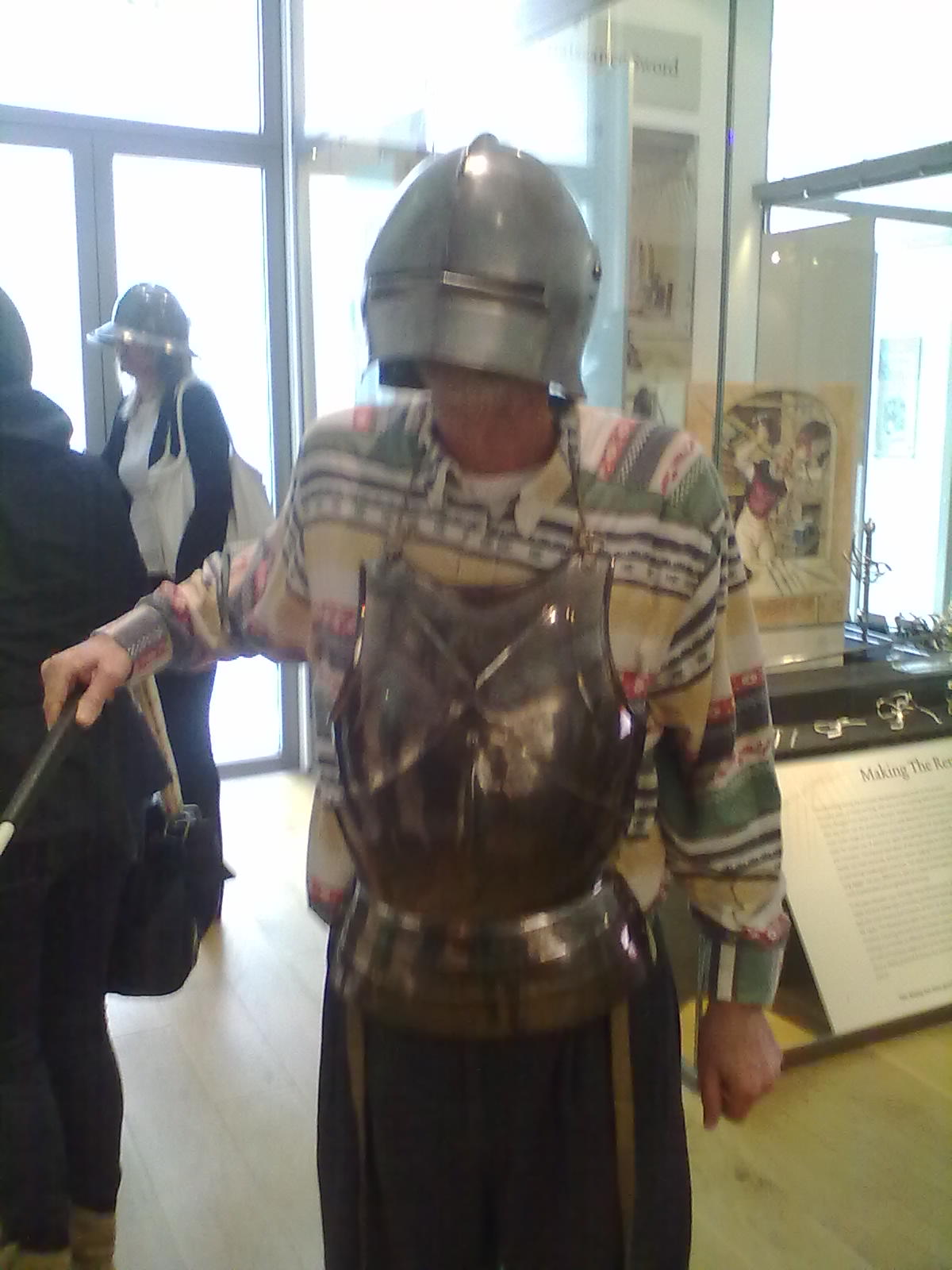
On exiting the exhibition area which is in the basement there is also an interpretation centre with lots of imaginative objects to handle and even wear. There is a tunic and collar of chain mail. This is very heavy and I resisted putting on this for now but I did put on a breastplate and a helmet with 2 slits acting as a visor. 


Knight in shining armour!
Wallace Collection
19/5/2012


Having the helmet on produced a strange effect on my ears.  Though the origin of the sound is of the sea shell variety, it was very tinny and I felt as if I were wearing a dustbin and probably resembled a Dalek more than ever.  I could not see anything through the visor and this probably illustrates my lack of central vision. 
Assuming the rapier was used in right hand the free hand had to be protected in a different way from the sword hand.  There is also a mystery object which can be felt and I won’t disclose what it is.

There are exhibits of the craftsmanship involved in sword making.  The same skills in handling gold and silver would have been employed in those artisan workshops in the manufacture of illuminated manuscripts and reliquaries. Milan seems to have been a centre of excellence for sword making and Bruges is also mentioned.


The Wallace Collection has another interesting exhibition which brings some life to Shakespeares dramas such as Romeo and Juliet.  Christopher Marlow came up in discussion - he was killed in a brawl in Deptford. During the summer the Wallace Museum is organising events and more details can be found on :


BBC Radio3 In Tune (Tuesday 22nd May 2012) featured the Wallace Collection and music by Monteverdi ‘Tancredi and Clarinda’.  Monteverdi had set a battle scene to music and the exhibition came up in the discussion about the piece.

TIP

For the time being, many buses have returned to familiar routes in the Portman Square area, though there is still some construction work in Baker Street.  Diversions along Wigmore Street seem to have stopped.